

The Complete Guide to Conversational Commerce in 2026: WhatsApp, AI Optimization, and Payment Innovation
The future arrives faster than we expect and slower than we hope.
I’ve watched decades of technology promises. Every January brings predictions that “retail is dead” or declarations that “this changes everything.” Most miss.
But 2026 is different.
The shifts defining commerce aren’t making headlines. They’re not about viral apps or shiny gadgets. They’re about how people buy, how they trust, and what they value when everything feels automated.
If you manage retail operations, marketing, or customer experience in Latin America, these aren’t trends to watch. They’re realities reshaping your business now.
Here’s what matters.
The Forces Reshaping Commerce
Ten major trends converge to redefine commerce in 2026. Each carries specific opportunities and risks. Look at the full picture before we dive deep:
| Trend | The Upside | The Risk | Interaction Type |
|
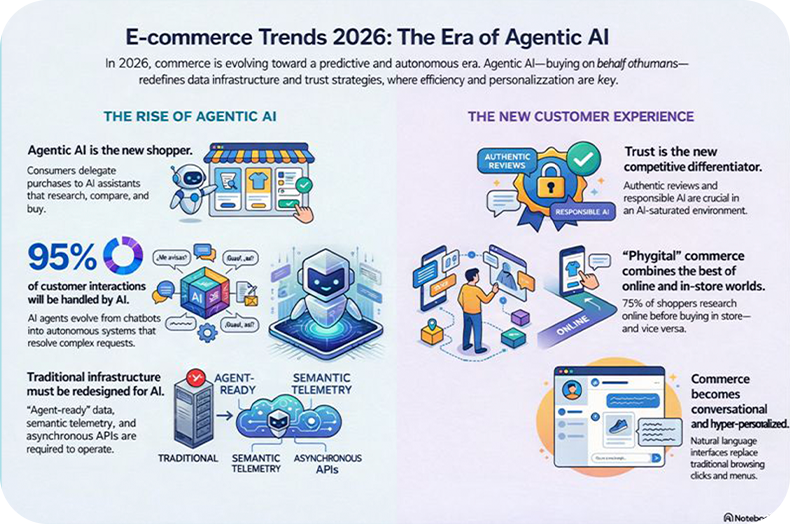
Agentic AI Commerce | Instant problem resolution, automated repeat purchases. Reduces errors 60%, accelerates execution 40%, cuts costs 25%. | Brand invisibility if agents prioritize only technical data; consumer “Trust Gap”; security risks without data governance. | Automated |
| Zero-Click Commerce | Eliminates sales funnel friction, enabling instant purchases from videos, chats, or answer engines. | Loss of direct website traffic (up to 40%) and high dependence on AI intermediaries. | Automated |
| AI Engine Optimization Conversational | Strategic positioning in AI assistant recommendations users consult before buying. | Total invisibility if data isn’t structured; dependence on third-party algorithms that may favor competitors. | Automated |
| Commerce & Super Apps | Unified engagement where customers discover and pay in a single chat thread; 98%+ open rates on WhatsApp. | Customers won’t tolerate friction; requires immediate 24/7 responses and absolute continuity. | Hybrid |
| Privacy & Zero-Party Data | Building proprietary databases based on preferences users voluntarily share. | Severe regulatory scrutiny; requires high-trust relationship for users to continue sharing. | Human |
| Blockchain & Digital Product Passports | Verification of authenticity, sustainability, and transparency; enables charging a “human premium.” | Technical complexity, high initial costs, need for extremely precise supply data. | Automated/Human |
| Augmented Reality & Spatial Commerce | Reduces returns by enabling “try before you buy” virtually; increases confidence. | High costs creating 3D assets and hardware limitations on low-end devices. | Hybrid |
| Hyper-Personalized IoT Ecosystems | Behavior tracking enables dynamic pricing, personalized promotions, and assisted purchases. | Critical privacy concerns as device network expands. | Hybrid/Automated |
| Hybrid Shopping (Phygital) | Immediate gratification of physical stores combined with digital efficiency (BOPIS/BORIS). | Risk of information silos if systems aren’t perfectly synchronized in real-time. | Hybrid |
| Voice Commerce 2.0 | Hands-free shopping integrated into daily routines; ideal for quick repurchase. | Difficulty verifying identity and fraud risk from voice spoofing. | Automated |
Six Trends Demanding Action Now
From these ten forces, six require immediate attention. Not because the others don’t matter—they do. But these six will determine who thrives and who struggles in the next 18 months.
1. AI Stopped Assisting—Now It’s Selling
By the end of 2026, a quarter of your customers won’t visit your website to buy. They’ll ask ChatGPT, Claude, or another AI to research and purchase for them.
This isn’t incremental change. AI evolved from tool to sales channel.
When a customer asks their AI, “Find me running shoes under $100,” will your brand appear? That depends on whether you’re optimized for AI discovery.
What this requires:
- Structured product data with schema markup AI can parse
- Detailed descriptions language models cite confidently
- Authentic reviews AI systems trust
- Brand authority through press coverage models use for rankings
The harsh truth: Brands treating AI like another marketing channel will lose. Brands understanding AI as a primary sales channel will dominate.
2. Physical Stores Return (Transformed)
While everyone predicted the “retail apocalypse”, physical stores staged a comeback. Coveo’s data shows physical commerce growth outpacing e-commerce.
The twist? These aren’t 2015’s stores.
U.S. shopping mall traffic increased 1.8% in early 2025. Stores transformed from transaction centers into experience destinations. They became the antidote to screen time.
Digital-native brands that existed only online now open physical locations. Not because online failed—because humans crave what digital can’t deliver: tangible experiences and genuine connection.
For Latin American retail, where in-person relationships always mattered, this vindicates what you knew all along.
The future isn’t fully digital. It’s intelligently hybrid.
3. “Human-Made” Became the Ultimate Luxury
As AI-generated products flood markets, an interesting rebellion emerged.
When algorithms design everything, authenticity becomes luxury. Consumers actively seek goods labeled “Human Made”—products with soul AI cannot replicate.
This creates powerful marketing: video content showing artisans at work converts better than any other asset for premium brands. Customers seeing the hands that created a product will pay more. They’re buying humanity, not just the item.
For businesses in Latin America with rich artisan traditions, this is your moment. The skills global brands fake with marketing, you possess authentically.
4. Transparency Stopped Being Optional
Sustainability moved from marketing slogan to regulatory requirement.
Starting in 2026, the EU’s Ecodesign for Sustainable Products Regulation mandates Digital Product Passports for certain categories. These “digital birth certificates” track a product’s complete lifecycle.
Customers scan a QR code on a shirt and instantly see where materials originated, the carbon footprint, and recycling instructions. What begins as European regulation rapidly becomes global expectation.
In Latin America, transparency builds trust in markets where trust is hard-won. When counterfeit goods and unclear supply chains eroded confidence, radical transparency becomes competitive advantage.
5. WhatsApp Isn’t a Channel—It’s Infrastructure
Here’s the stat reshaping customer engagement: 87% of Latin American companies use WhatsApp for customer communication.
This isn’t a trend. This is infrastructure.
While U.S. retailers debate which messaging apps to support, Latin American businesses already know. WhatsApp is the region’s digital dial tone. Customers expect to message businesses there for everything—product inquiries, negotiations, delivery coordination.
The winners aren’t businesses with fancy websites. They’re businesses showing up where customers already live: in WhatsApp conversations.
The evolution now moves from reactive customer service to proactive conversational commerce—AI chatbots handling routine inquiries 24/7, escalating complex issues to humans, processing payments within chat threads.
The implementation reality:
- WhatsApp Business API for scale
- AI chatbots for first-line inquiries
- Human agents for complex situations
- Integrated payments within conversations
- CRM systems maintaining conversation history
If you’re not building this infrastructure now, you’re already behind.
6. Payment Innovation: The Hidden Conversion Lever
The final purchase step—payment—is where sales die. By 2026, payment flexibility separates conversion from abandonment.
Consider Brazil’s Pix: within two years, two-thirds of Brazilians adopted this instant payment system. It now handles more e-commerce transactions than credit cards. Instant. Free. 24/7.
Fact: nearly 70% of Latin American consumers resist buying from sites not accepting local payment methods. If your checkout only accepts international credit cards, you’re losing half your market.
Modern checkout requirements:
- Local payment methods (Pix, OXXO, ACH, local cards)
- Installment options (“12 cuotas sin interés” isn’t optional—it’s expected)
- Digital wallets for one-tap mobile checkout
- Buy now, pay later options
- Multiple currencies with real-time conversion
Brands treating payment as afterthought watch carts abandon. Brands optimizing for local payment preferences see conversion soar.
The Pattern Behind the Chaos
All these trends share one thread: technology serves humanity, not the reverse.
Businesses thriving in 2026 understand that AI, transparency tools, and digital infrastructure exist to create better human experiences. The goal isn’t removing people from commerce—it’s removing friction from human connection.
As AI becomes prevalent, authenticity becomes valuable.
As digital expands, physical experiences become cherished.
As automation increases, transparency and trust become non-negotiable.
The bottom line: you should use technology to strengthen the human elements that always drove commerce: trust, connection, and authentic value.
Insights & Trends